SUBJECT: Educational Service
Provider Modules for Remote Locations
PURPOSE OF PROPOSAL
The purpose of this proposal is to persuade commercial or government
philanthropic or public educational institutions to consider the following
modular technology solution to the education of remote learners.
TABLE OF CONTENTS
| PURPOSE
OF PROPOSAL |
2 |
|
TABLE
OF CONTENTS |
2 |
|
NEEDS |
3 |
|
OFFERED
BY THIS PROPOSAL |
4 |
|
BENEFITS |
5 |
|
CONTENTS OF THIS DOCUMENT |
6 |
|
PROBLEM AND ITS SIGNIFICANCE |
6 |
|
PROPOSED SOLUTION |
6 |
|
BUILDING |
7 |
|
ELECTRICAL |
7 |
|
POWER |
8 |
|
INTERNET ACCESS |
8 |
|
LOCAL
AREA NETWORK |
9 |
|
NETWORK
CONNECTIVITY HARDWARE |
9 |
|
COMPUTERS |
10 |
|
SAFE |
10 |
|
MONITOR |
11 |
|
PRINTER/FAX/SCANNER/COPIER |
11 |
|
PAPER |
11 |
|
CABINETS |
12 |
|
SOFTWARE |
12 |
|
TRANSLATION |
12 |
|
CURRICULUM AND PEDAGOGY |
13 |
|
SECURITY
|
14 |
|
POSTAL SERVICE |
15 |
|
EVALUATION |
15 |
|
TOILET |
16 |
|
STAFFING REQUIREMENTS |
17 |
|
LOCAL JOBS |
17 |
|
INTERNATIONAL JOBS |
18 |
|
AFFIRMATIVE ACTION |
18 |
|
PROGRESS
REPORT |
18 |
|
BUDGET |
20 |
|
RESTATMENT
OF BENEFIT |
21 |
|
THE AUTHORS
INTEREST IN THE WORK |
21 |
|
REFERENCES |
22 |
|
APPENDIX |
25 |
NEEDS
Dr. Yunus, the creator of
Grameen Banking that began giving micro-loans to poor women in 1976 with
profound results, gave the following statement about the needs of the poor.
I
see [the] alleviation of poverty as a do-able proposition. We can remove poverty
from the surface of the earth only if we can redesign our institutions - like
the banking institutions, and other institutions; if we redesign our policies,
if we look back on our concepts, so that we have a different idea of poor
people.
Because
at present poor people are looked upon as if they have to be dependent on
somebody's handout, on somebody's mercy. They are NOT looking out for
somebody's handout, they are NOT looking out for somebody's mercy.
They
want their legitimate due - and they can handle the rest themselves. They can
pull themselves out of poverty (Yunus, 2001).
For Dr. Yunus, credit is as fundamental a human right as the
right to freedom of speech, food, shelter, health, or education. The author of
this proposal wishes to stress the right to an education. If micro loans can
revitalize communities, education can make contributing world citizens out of
the individuals who make up those communities.
The
United Nations Educational Scientific and Cultural Organization (UNESCO) has
always emphasized the linkages between culture and the broader aims of human
endeavor. This has been part of its core constitutional mandate of
"advancing, through the educational, scientific and cultural relations of
the peoples of the world, the objectives of peace and the common welfare of
mankind" (UNESCO, 2001).
The fact that education is an important part of that international organization’s goals emphasizes the need to educate the global public. This author share’s the educational goal of UNESCO.
OFFERED BY THIS PROPOSAL
The education of remote populations is a unique challenge and will be addressed in the form of Educational Service Provider Modules (ESP Modules). The modular technology lab classrooms could easily be adapted to locations with public service utilities. The challenge of this proposal is to meet the needs of the most remote populations by listing the items required for a completely isolated location.
Put simply, the ESP Modules can be assembled for almost any population that will accept the responsibility of security and participation. In return the local population will be offered education, Internet access, postal service, on-site jobs, potential for international off-site jobs, and additional ESP Modules based on the success of the first module. Figure 1 is a possible configuration of an ESP Module.
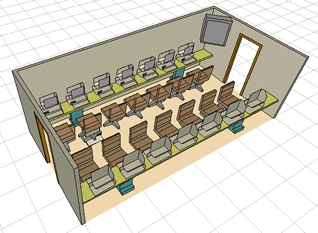
Figure
1
Educational Service Provider Module
BENEFITS
The
following research demonstrates that individualization, novelty and systematic
presentation are the requirements for successful instruction. The author wishes
to make the point that it is just such individualization, novelty and
systematic presentation that can be much improved with the assistance of
computers.
Bloom’s (1971) monograph on the “Individual
differences in School Achievement” points to the rolls played by the various
aspects of an educational environment. Bloom states that 50% of student
variance is attributable to ENTRY BEHAVIOR, 25% to AFFECTIVE ENTRY
CHARACTERISTICS and 25% to the QUALITY OF INSTRUCTION. Bloom continues by
explaining those three sources of variance in student success. He states that
teaching a frustrating population of students can be 50% easier if a short
amount of time is spent catching up the less experienced individuals in the
classroom. Bloom said that the job could be made 25% easier by disassociating
the student’s present educational experience with past unpleasant experiences.
Finally the job of teaching can become 25% easier when the teacher uses
researched lesson cycles to present the material.
In
April of 1999 the author performed research comparing student success with
computer-based testing vs. traditional testing. It was clear that the students
demonstrated many less discipline problems when the author taught his lessons
in the computer lab. So the author wished to learn if student test scores would
improve by simply taking their tests on computer. Group 1 had a mean score of
59.32 (traditional paper test) and Group 2 had a mean score of 67.20
(computerized test). The t-test results
between the two groups of learners demonstrated that there was a 0.009 level of
probability of obtaining the sample means as far apart as 7.88 by chance alone.
It is the author’s opinion that student interest in computers is so pervasive
that even traditionally distasteful instructional tasks are approached with
alertness.
Bloom’s
research and this author’s research both call for the use of individualization,
novelty, and systematic presentation, which are some of the most striking
features of computer assisted instruction. Combined with the authors thirteen
years of classroom teaching the preceding research has convinced the author
that technology is the most desirable tool and subject of study, for
challenging remote populations.
The global community is in need of world-citizenship building skills based on the cornerstone principles of cultural pluralism. Cultural pluralism is accomplished by exercising equality, mutual acceptance, understanding and a sense of moral commitment focused on the intra- and intergroup relationships of individuals and their inherent rights (Baptiste and Baptiste, 1979). A diverse but unified population with access to international information and organized instruction can become a production line for productive global citizens.
CONTENTS OF THIS DOCUMENT
The
cost, schedule and quantity of the remote classrooms must be adapted to the
individual site, however this document prescribes a basic system of remote
housing, electrical power, Internet access, workstations, workstation
networking, sanitation, curriculum, financial autonomy, security and adaptation
to the local culture.
THE PROBLEM AND ITS SIGNIFICANCE
Many remote locations do not have access to contemporary technology or information. The resulting divide between the haves and have-nots can create dangerous resentment.
PROPOSED SOLUTION
The components that make up Educational Service Provider Modules are easy to access in many countries. This author proposes a list for assembling such modules, which does not depend on one source for the components. There is cause for hope among remote populations, when individuals who possess the financial resources to use the author’s research, come to know that the tools are at hand to disseminate independence building skills. The specifications of the ESP Modules are as follows.
Building
A portable shelter is leased or purchased from a manufacturer or dealer nearest to the site. The cost including transportation, anchoring and set up is approximately $11,000 for 2 connected 12 X 12 X 8 foot rooms. Figure 2 is an example of a 12 X 12 modular building that costs $30.02 per Square Foot or $4324.00.
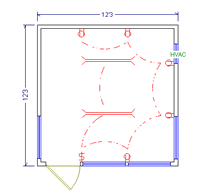
Figure 2.
Birds eye view of one commercially accessible
modular building
Building Specifications
· 8' tall Standard Walls 4 mil vinyl clad 1/8" hardboard on polystyrene foam core 3" thick
· Steel Door with 3/16" tempered safety glass window
· (4) Windows 3/16" tempered safety glass w/steel frame
Electrical
An electrician will only be required to bring power to the building and complete the hook-up at the breaker panel. The electrical features that are included with each 12’ X 12’ unit are as follows.
· (1) Light Switch
· (5) 110 volt Outlets
· (2) Light Fixtures, 2' x 4' less bulbs
· (1) Breaker Panel
· 144 sf. Roof Deck 22 gauge prime painted ribbed steel deck
· 144 sf. 2' x 4' Class A non-combustible mineral fiberboard ceiling tiles
· (1) 5000 BTU A/C 110 volt breaker box
Self-installation requires approximately 1 day for two men. It can be professionally installed within the US for $2007.00. (Mcgill and Company, 2001)
Power
A EU3000IS generator, or its equivalent powers the mobile room. It is a quiet generator with the 3000-Watts needed for the 14 computers, lights, a television monitor, video player (DVD or VHS) and printer/copier/scanner/fax combo. The generator is only 135 lbs. and will operate almost 20 hours on less than 3.5 gallons of gasoline for $1,590.00. (Southwest Fastner, 2001)
Internet Access
Internet
access is necessary for communication with potential employers, software updates,
distance learning, research, and post office applications. Internet access
is acquired via satellite if there is no local provider. No phone line or
dial-up is needed with StarBandTM satellite access.
Installation and Cost
- Model 360-satellite modem, 24” x 36” satellite
dish, mounting parts and hardware. $599.99
- Professional Standard Installation by a
Certified StarBand Installer $299.99
- Shipping and Handling $59.95
- StarBand Only $959.93
DISHtm Network Satellite TV
Package
- 150+ Television Channels
- Free Installation
- In-Home Service Plan
- Free First Month of Programming
- DISH Network Activation Fee: $49.99
- StarBand $959.93
- Total $1009.92
Monthly Satellite Internet Access
Subscription Fee
- Option 1:(StarBand Service Only) Unlimited
Internet $69.99 a month.
- Option 2: Unlimited Internet and 150 Channel
Television Package $99.99 a month.
The one-year service commitment requires that the computers meet minimum system requirements and the line-of-sight requirements with the satellite. The prices do not include the local taxes and there are additional mileage charges relative to the remoteness of the location. To qualify for the DISH Network offer, the benefactor of the ESP Module must have a major credit card and must be a 1st time DISH Network customer (StarBand, 2001).
Local Area Network
The
ESP Module is networked with a star topology to provide Internet and printer
access to all the computers. Each computer must have an Ethernet card connected
by an RJ45 jack to Level 5 cable. Network wiring will cost $ 9.50 X 15. All the
cables from every computer connect to a hub near the teacher’s computer. The
hub receives its data signal from the satellite dish. All the computers have
access to the local area network (LAN) but the teacher’s computer is setup as
the administrator and the student computers as users. In this way the teacher
may use group permissions to control access to administrative tools and
software (CODE Micro, 2001).
Network Connectivity Hardware
The
SUPERSTACK 3 BASELINE HUB 24PORT [P/N 3COM - SWI 3C16441A-US] is available at
codemicro.com for $223.55. It meets the performance demands of ESP module for
reliability, expandability and ease-of-use. It is a higher capacity hub with
24, 10 Mbps Ethernet ports and a transceiver module port, which connects to a
range of network backbones. This hub is not stackable and the power
requirements are as follows:
Input voltage: 100?V,
frequency: 50/60 Hz, Consumption: 34/44W (CODE Micro, 2001)
Computers
Laptops
are suggested for computer application lessons. Desktop computers are used for
hardware lessons. 14 inexpensive laptops can be purchased presently at the
following price and configuration, (Notebookcomputer.com, 2001):
|
Prostar 2253H |
|
4X-AGP up to 64MB Video |
|
Firewire |
|
Free Case |
|
Windows 98/ME |
|
MUST MENTION PRICE WATCH |
|
Pentium® III 1GHz |
|
13.3inch |
|
128MB (512M max) |
|
10GB Hard Drive |
|
56k Modem |
|
10/100 Network Card |
|
24X CD Drive (DVD/CDRW option) |
|
Free Shipping as of 9/15/2001
9:58:40 AM CT |
|
888-654-6550 |
|
3213-B Solomon’s Island Rd. |
|
Suite 107 |
|
Edgewater, Maryland 21037 |
|
Price $ 1139 |
Safe
A safe or strong box will
need to be secured to the metal frame of the building. This will be necessary
to contain the mail received for the community, all the software required for
the computers and a digital camera. The SENTRY V120 anti-theft safe with key
lock would have enough room for the few items that would require this level of
security. It is item No. 429187 at Staples (2001).
Monitor
A television monitor is
attached to the wall near the teacher’s computer in plain view of all the
students. The Monitor is attached to the teacher’s computer and to a video
player so the students and staff may see the teacher and video demonstrations.
Sanyo 36" Stereo TV — AVM-3651G 2
A/V inputs with S-video; fixed/variable audio output; comb filter; MTS stereo
sound and SAP capability; scan velocity modulation $649.99
Printer/Fax/Scanner/Copier
Graphics
lessons, postal functions, and student reports will require a multifunction
machine. Recently such machines have become affordable. The Brother
MFC-7300 Color Multifunction Machine Unit
# 441061 presently costs $249.98.
The specifications are as follows:
|
12 pages per minute (ppm)
black or 10 (ppm) color printing |
|
1200 x 1200 dpi photo quality
output |
|
Black and white or color
faxing |
|
High quality scanning up to
2400 dpi |
|
Black and white or full color
copies |
|
Extra cartridges are $21.99
each |
System
Requirements:
Windows
95/98/NT/2000/ME or Mac OS.
Paper
If the location is very remote extra cases of paper
may be practical on the first implementation of the ESP Module. Georgia-Pacific
InkJet Paper can be purchased at Staples, (2001). The 20 lb., 90 brightness,
8 1/2" x 11" sheets are item No. 487108 and cost $18.49 for a 2500
page case.
Cabinets
Above the computers and against the walls
will be space for storage cabinets. If the selected building supplier does
not have a cabinet option there is an excellent choice of office furniture
at Office Depot, Staples, or Home Depot.
The walls
have room for eight sets of Tennsco 4-compartment wall mount lockers. They come
in sand color and item no. TNN106723 costs $175.56. Each set comes with 4
lockers and the compartments are 12”H x 12”W x 18”D. They also have a 48” coat
rod for hanging garments underneath. Multiple rows of lockers can be grouped
with standard nuts and bolts. (Staples, 2001)
Software
The suggested software will
be selected from the following list because skills in their use are commercially
valuable and because a teacher is available to teach them:
|
· Paint Shop Pro |
$109.00 |
· Word |
$179.98
|
Translation
The
curriculum must be translated from the software and hardware manuals rather
than from outdated texts. Microsoft products will be an important part of the
curriculum and their menus and fonts can be converted to the following
languages with what is called “localized tools”. The following languages can be
downloaded from Microsoft (2001). Arabic, Dutch, Italian, Russian, Basque,
Finnish, Japanese, Slovak, Chinese (Pan), French, Korean, Slovenian, Chinese
(Simplified), German, Norwegian, Spanish, Chinese (Traditional), Greek, Polish,
Swedish, Croatian, Hebrew, Portuguese (Brazilian), Thai, Czech, Hindi,
Portuguese (Iberian), Turkish, Danish, Hungarian, and Romanian. The localized
tools may be downloaded at the following URL. http://www.microsoft.com/office/ork/2000/appndx/toolbox_localized.htm
Curriculum and Pedagogy
Supplying Internet access to a remote
population also provides an extraordinary number of instructional sources (Virtual.net.uy, 2001). However the web sources do not automatically stratify themselves into
lessons that are appropriate for individual learners. Some of the profound
qualities of computers are their tireless availability, adaptiveness, and
organization qualities. Rather than separating the students into grade levels,
it is suggested by the author of this proposal that the students take advantage
of computerized criterion referenced teaching/ tests or a hierarchy of
evaluative/instructional tasks.
There is little need for isolated tests except when
instructing the student in test taking strategy. Instead, the student will be
evaluated as he or she participates in instructional tasks and then will be
supplied with subsequent appropriately challenging tasks. (Buros Institute, 2001).
Security
Any community who wishes to receive one
or more of the ESP Modules will need to have a commitment signed by a
representative cross section of the community to protect the equipment,
(Appendix A). Such a document would have little legal value in a truly remote
location but it would serve to instill psychological responsibility in the
recipients.
All peripherals, computers and portable toilets will be attached with cables to the metal frame of the building. The DEFCON CL Notebook Cable Lock is 6.5 ft. of galvanized steel with a security base plate. It costs $ 29.99 at Computers 4 Sure.com (2001).
Self-destructive
vandalism and jealousy driven conflicts will be addressed with a research of
the local folklore and cultural norms.
Impression management techniques will precede and accompany the
implementation of the modules into any location. Many conflicts can be resolved with proliferated local
equivalents of stories like the “goose that laid the golden eggs” and the
“grasshopper and the ant”. The United Nations Educational, Scientific and Cultural
Organization (2001) has valuable information to assist individuals preparing
for relocation to another culture. Their research can be accessed at the
following URL: http://www.unesco.org/culture/links/.
Participants
such as teachers, equipment installers and evaluators can prepare for the trip
by reading the travel warnings web page provided by the (U. S. Department of
State, 2001) at the following URL: http://travel.state.gov/travel_warnings.html.
Postal Service
Online postage is trademarked
as PC Postage by the Postal Service. It is based on the concept of electronic
stamps that look like bar codes. PC Postage allows you to buy your postage
online from companies authorized by the Postal Service and print it directly
on to your own labels and envelopes. All you need is software from the Postal
Service, and in some cases, a software/hardware combination from the third-party
postage company (Kaukab Jhumra, 2000).
Pitney Bowes Personal Post
Meter Kit is Item No. 836270 at Staples Office Supply (2001) for $49.99.
Individuals can calculate the
postage for most items with the Internet tools supplied by the United States
Postal Service web site. (U.S. Post Office, 2001) http://www.usps.com/. Internet postage can also be accessed at http://Stamps.com/.
Evaluation
The expansion or removal of ESP
Modules will be based on evaluations of student progress. The author of this proposal has experience
with computer-based instruction and has found that the students always want
more. In a situation where there are only thirteen student positions the competition
will be great in a larger population. For this reason the student/staff selection
process will have to be an important part of the information, which precedes
the installation of a Module.
The following standardized test is just one
of the tests which may be used to stratify the population into study groups and
potential employees.
Title: Kaufman Brief Intelligence Test.
Author: Kaufman, Alan S. Kaufman, Nadeen L.
Abstract: Brief individually administered
measure of verbal and nonverbal intelligence for people aged 4-90. Developed
specifically for screening purposes and for those situations where it would be
difficult to do a more in-depth assessment. Norms are provided for all ages.
Composed of two subtests, vocabulary and matrices. Vocabulary measures verbal,
school-related skills by assessing word knowledge and verbal concept formation.
Matrices measure nonverbal skills and ability to solve new problems. Items in
matrices subtest involve pictures and designs. (Buros Institute, 2001)
Test Acronyms: KBIT
General Notes: TIME: 30; approx. ITEMS: 130.
Publication Date: 1990
ETS Tracking Number: TC017189
Toilet
Waterless toilet facilities assist in bringing the
educational modules to areas without plumbing. The Envirolet™ waterless remote
toilet specifications are as follows.
|
POWER |
|
PERSONS
PER DAY* |
|
|||||
|
System/Model |
Power Type |
Min. |
Max. |
Standard |
Weight |
Vacation |
Continuous |
||
|
RS/W NE |
Non-Electric |
Nil |
Nil |
White |
110 lbs. |
6 |
4 |
||
|
RS/W 12v |
12v Battery |
0.3A |
0.6A |
White |
118 lbs. |
8 |
6 |
||
|
RS/W 110v |
110v Electric |
40W |
540W |
White |
120 lbs. |
10+ |
8 |
||
The size of the waterless toilet is 16.5" in width x 22.5" in length/depth x
20.5" in height (Height to toilet seat 15"). The *toilet
capacity as noted in the chart suggests a person per day rating is based
on three uses per person per day. All Systems will handle occasional additional use.
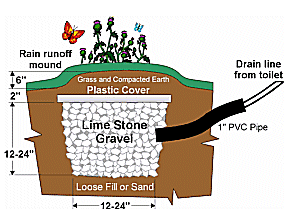
Figure 3
Image
from http://www.envirolet.com/enwatremsys2.html
Toilet
Power Sources and Pricing
|
Non-Electric |
|
|
|
12v
Battery |
|
|
|
110v
Electric |
|
|
|
12v/110v
Hybrid |
A
sign must be placed on the door of the toilets to state the maximum number of
uses per day. (Envirolet™ ,2001)
STAFFING REQUIREMENTS
Local Jobs
There will be
an immediate need for trustworthy and dedicated custodians and security
officers. Shortly thereafter there will be a need for a post office worker,
teachers and technicians.
The
local populations are candidates for all the employment opportunities. Instructions for running the post office,
using the Internet, applying for international offsite jobs, grant writing for
additional classrooms, cleaning and maintaining the modular schoolroom and
waterless toilets are provided as video demonstrations.
International Jobs
There
will be an opportunity for graduates of the program to seek funding for additional
ESP Modules for use as independent entrepreneurial projects. The schoolroom
contains a commercial postal service and/or international contract programmer
groups to assist in funding of the operation.
Affirmative Action
Based
on the research into any local culture that receives an ESP Module, the jobs
may be divided among qualified individuals based on a balance of criteria.
In many countries there have been great financial benefits to the inclusion
of previously oppressed groups in the work force. An example is the group
who provides small loans to Asian Indian women that have had profound effects
on the economy and the power structure in some communities.
PROGRESS REPORT
Date: 9/3/01
TO: Contributer
FROM: Joe Broome
SUBJECT: Progress Report
for Proposed Educational Service Provider Systems In Remote Locations
INTRODUCTORY SUMMARY
This author was assigned
to create a formal proposal for a mobile education system to service remote
populations with contemporary technology.
This document is a report of Joe Broome’s progress.
Overview
- Phase 1: On the 21st of August 2001
a four page abbreviated Proposal was submitted.
- Phase 2: On the 3rd of September
2001 a four page Progress Report was submitted.
- Phase 3: On the 12th of September
2001 a twenty to thirty page Proposal will be submitted.
Since Last Report
Mr. Broome has interviewed
the owners of a commercial post office regarding applications, licensing and
equipment needed for the installation of a post office. The author has also gathered a list of the
technology and prices required.
Finally, the abbreviated Proposal was updated with the suggestions
provided by the members of the TS7000 Think Tank of which the author is a
member.
RESEARCH COMPLETION DATES
|
TASK |
TIME |
|
Portable Offices leasing, purchase, transportation,
anchoring, pricing. |
8/10/2001 |
|
Power sources (generator) pricing. |
8/10/2001 |
|
Satellite Internet access pricing. |
8/12/2001 |
|
Networking hardware and software pricing. |
8/10/2001 |
|
Locking cart of laptops. Desktop computers for hardware lessons. |
8/10/2001 |
|
Security cables for computers. General Security. |
8/12/2001 |
|
A formula for cleaning and maintaining the modular
schoolroom and waterless toilets for the local population employees. |
|
|
A formula for training the local populations for
employment as teachers, security, post office workers and grant writers. |
9/3/2001 |
|
A formula for research of the local folklore and
cultural norms for Impression management to precede and accompany the
implementation of the modules. |
|
WORK PLANNED
|
TASK |
TIME |
|
A formula for cleaning and maintaining the modular schoolroom
and waterless toilets for the local population. |
9/7/2001 |
|
A formula for research of the local folklore and
cultural norms for Impression management to precede and accompany the
implementation of the modules. |
9/9/2001 |
BUDGET
The budget will be relative to the location but the standard one classroom module will cost approximately $ 108,457.47
Item |
Unit |
Total/Year |
|
Building |
$ 11,000.00 |
$ 11,000.00 |
|
Generator |
$ 1,590.00 |
$ 1,590.00 |
|
$ 1,525.00 X 2 |
$ 3,050.00 |
|
|
Satellite and ISP |
$ 1009.92 |
$ 1009.92 |
|
Wiring |
$ 9.50 X 15 |
$ 142.50 |
|
Hub |
$ 223.55 |
$ 223.55 |
|
Laptops |
$ 1139 X 14 |
$ 15,946.00 |
|
Notebook Cable Lock |
$ 29.99 X 22 |
$ 659.78 |
|
Multifunction Machine |
$ 249.98 |
$ 249.98 |
|
Extra Ink Cartridges |
$ 21.99 X 10 |
$ 219.90 |
|
Post Meter Kit |
$ 49.99 |
$ 49.99 |
|
InkJet Paper |
$ 18.49 |
$ 18.49 |
|
Unlimited Internet |
$ 69.99 Monthly |
$ 839.88 |
|
Gasoline (gallon a day) |
$ 1.50 Daily |
$ 547.50 |
|
Teacher’s Salary/Benif. |
$ 40,000.00 |
$ 40,000.00 |
|
Software and Licenses |
$ 32,200.00 |
|
|
Television |
$ 649.99 |
$ 649.99 |
|
Cabinets |
$ 1,404.48 |
|
|
|
|
RESTATMENT OF BENEFIT
The
preceding list of items, when skillfully combined can accomplish the individualization,
novelty, and systematic presentation, which are needed in any educational
environment. The author suggests that a postal service, technology instruction,
the few local jobs, potential for international jobs and hope for the future
of the community are all profound benefits supplies by the ESP Modules.
THE AUTHORS INTEREST IN THE WORK
The
author has a vested interest in educating as many individuals as possible
because of his dedication to the career of teaching and because of his conviction
that, only by educating the international public can he make the world safe
for his family. Communication, technology,
community, and family all play important roles in the implementation of the
author’s Educational Service Provider Modules.
This
author is very enthusiastic about implementing this proposal. He is a member of the American Indian Tribe
of Choctaws and wishes to make the first application of the modular classrooms
for the tribe. He has also made a
contact with an individual from Jamaica who has committed to deliver the
proposal to the appropriate authorities.
The author has also been invited by his Jamaican contact to stay in
Jamaica at no expense (except travel) to meet with any officials who wish to
take advantage of his research.
The
author recommends that individuals, companies or government institutions
wishing to educate remote populations, use this proposal to assist in the
creation of educational environments, where they are most needed.
REFERENCES
Needs
Armstrong, P., Vittachi, A.,
(2001) “Credit Where It's Due” Worldview International Foundation (WIF)
Bangladesh. [On-line]. Available:
http://www.oneworld.org/beijing/yunus.html
United Nations Educational
Scientific and Cultural Organization (2001, 12 Sep.). “Promotion of
International Education.” [On-line]. Available:
http://www.unesco.org/culture/development/
Pedagogy
Bloom, B. S., (1971).
Individual differences in School Achievement; A Vanishing Point? American
Educational Research Association Monograph.
Multicultural Information
Baptiste, H. P., Baptiste
M. L. (1979). Developing The
Multicultural Process In Classroom Instruction. University Press of
America, Inc.
Portable Buildings
Mcgill and Company. (2001,
6 Sept.). “Portable Building Vender” [On-line]. Available: http://www.mcgillandcompany.com/
*Budget Office Space Ltd. (2001, 21 Aug.). “Portable & Industrial
Buildings.” [On-line]. Available: http://www.budgetofficespace.co.uk/
*Chalmers, K. (2000, 6 Nov.). “Civic center area will receive new
portables.” [On-line]. Available: http://www.metroactive.com/papers/saratoga.news/11.08.00/civic-center-0045.html
Generators
Southwest Fastener. (2001,
12 Sept.). “Gas Powered Generator Vender.” [On-line]. Available:
http://www.southwestfastener.com/productsHonda.htm
Internet Access
Starband. (2001, 6 Aug.).
“Satellite Internet Access Provider.” [On-line]. Available: http://www.StarbandDepot.com/
Welcome to Tachyon. (2001,
21 Aug.). “Satellite Internet Access Provider.” [On-line]. Available: http://www.tachyon.net/
Network Hardware
CODE
Micro. (2001, 3 Aug.). “Network Hardware Provider.” [On-line]. Available: http://www.codemicro.com/ or
Notebook
http://www.staples.com/products/spotlights/pnb/default.asp
Translation
Microsoft, (2001, 14 Sep.). “Localized Tool Provider" [On-line]. Available: http://www.microsoft.com/office/ork/2000/appndx/toolbox_localized.htm
Pedagogy
Hunter, M. (1979).
Diagnostic teaching. The Elementary School Journal, 80, 41-46.
Curriculum
Virtual.net.uy, (2001, 15
Sep.). “Free Curriculum Provider” [On-line]. Available:
http://virtual.net.uy/netfree.html
Evaluation
Buros Institute, (2001, 15
Sep.). “Mental Measurements Yearbook and Reviews” [On-line]. Available: http://www.unl.edu/buros/
Security
Computers 4 Sure.com,
(2001, 12 Sep.). “Security Cable Provider” [On-line]. Available: http://www.computers4sure.com/
U.S.
Department of State. (2001,6 Sep.). “Travel Warnings & Consular Information
Sheets” [On-line]. Available:
http://travel.state.gov/travel_warnings.html
Kaukab Jhumra, (2000 12 Dec.). “BuyerZone.com
Assistant Content Writer” [On-line]. Available:
http://www.buyerzone.com/features/news_and_deals/tips121300-3.html
Postal Service
Fedex. (2001, 6 Sep.).
“Fedex Company Web Site” [On-line]. Available: http://www.fedex.com/
Stamps.com. (2001, 12
Sep.). “Postage Supplier.” [On-line]. Available: http://Stamps.com/
Waterless Toilets
Envirolettm
Composting Toilets. (2001, 13 Sep.). “ Waterless toilet Provider.” [On-line].
Available: http://www.envirolet.com/enwatremsys2.html
Technical Writing
Pfeiffer, W. S. (2001). Pocket guide to technical writing.
Prentice-Hall, Inc.
Pattow, D. (1998). Communicating Technical Information (2nd
ed.) New Jersey, Prentice-Hall, Inc.
APPENDIX A - Example Commitment Letter
|
Joe Broome 1754
Floral Ct. Crofton,
Maryland 21114 (410)
451-3779 Gregory E. Pyle Chief of the Choctaw Nation of Oklahoma P.O. Drawer 1219 Durant, OK 74702 (800) 522-6170 Fax (580) 924-4148 Dear Chief Pyle: Thank you for your interest in our Educational Service Provider
Modules. ESP Modules can be assembled for any population
that will accept some responsibility for security and participation.
In return the local population will be offered education, Internet
access, postal services, on-site jobs, potential for international
off-site jobs, and additional ESP Modules based on the success of
the first module. Please assist in obtaining support from the community by
reaching out to your community members. Signatures of individuals
who wish to participate as students, employees, or neighborhood watch
security will serve to unify the community and build trust with your
Educational Service Provider. We have the highest expectations for the success of the members
of your community. Thank you, Joe
Broome |
|||||||
|
Commitment Letter Signature
Sheet |
|
||||||
|
Name |
Address |
Phone |
e-mail |
Student |
Staff |
Security |
|
|
|
|||||||
|
|
|||||||
|
|
|||||||
|
|
|||||||
|
|
|||||||
|
|
|||||||
|
|
|||||||
|
|
|||||||
|
|
|||||||
|
|
|||||||
|
|
|||||||
|
|
|||||||
|
|
|||||||
|
|
|||||||
|
|
|||||||
|
|
|||||||
|
|
|||||||
|
|
|||||||
|
|
|||||||
|
|
|||||||
|
|
|||||||
|
|
|||||||
|
|
|||||||
|
|
|||||||
|
|
|||||||
|
|
|||||||
|
|
|||||||
|
|
|||||||
|
|
|||||||
|
|
|||||||
|
|
|||||||
|
|
|||||||
|
|
|||||||